The Washington Monument: DC's Best-Kept Secret for Street Photography
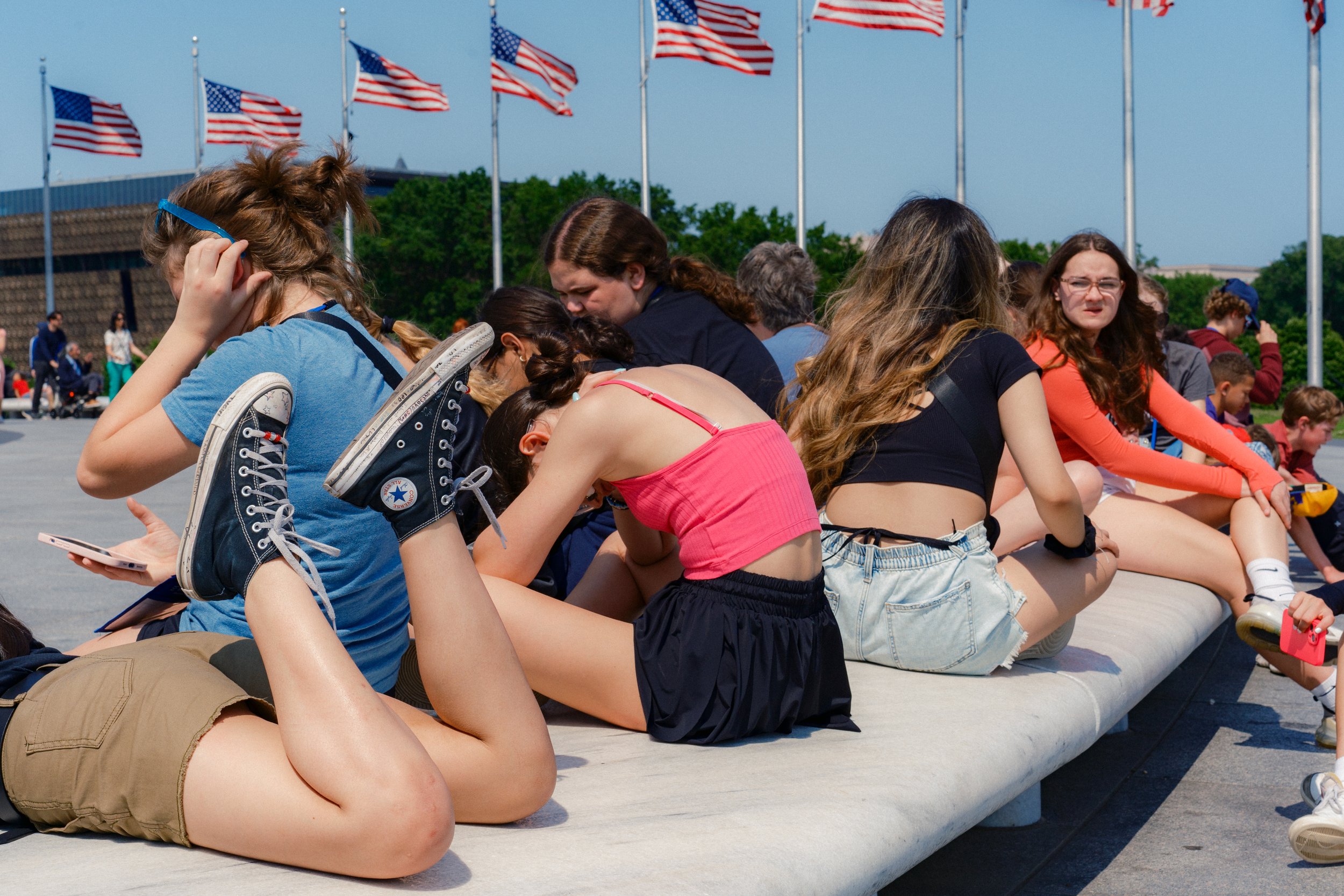
A School Group Relaxes at the Washington Monument
There's a reason so many street photographers who visit Washington DC aim their lenses at the monuments — they're surrounded by people, soaked in symbolism, and lit by some of the most reliably dramatic light in the city. But of all the iconic structures on the National Mall, the Washington Monument might be the most versatile and underrated backdrop for candid street photography. I've shot here across multiple seasons, in bright summer sun and cold winter air, and it keeps delivering.
Here's what I've found — and what these images say about why this location works so well.
The Wall Does the Work
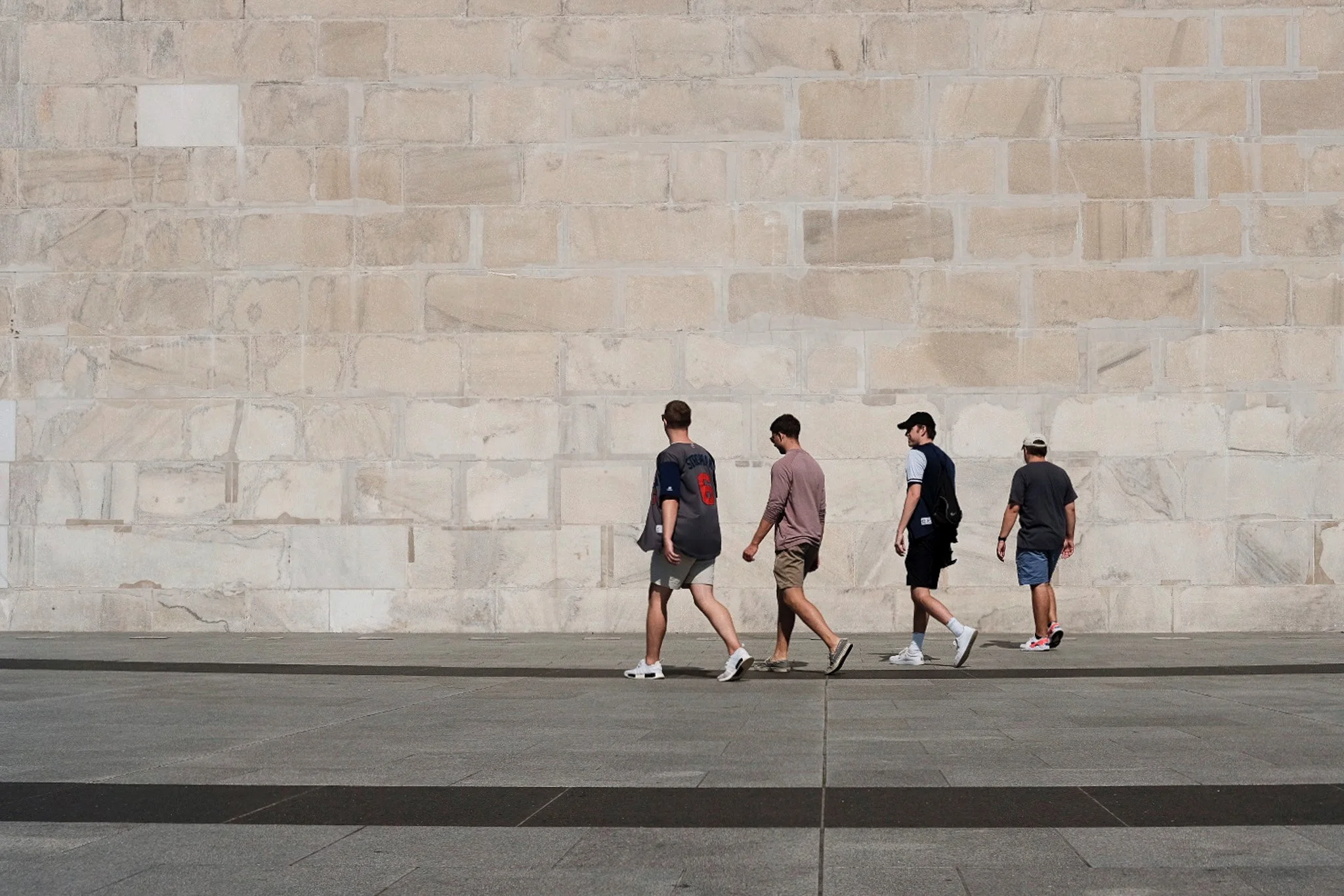
Four Men Walk in Front of the Washington Monument
The first thing you notice when you start shooting at the Washington Monument is the wall. Those massive marble blocks stretch in every direction, and they function as an almost perfect backdrop: neutral enough to let your subjects breathe, textured enough to give the frame depth. Whether you're shooting color or black and white, the stone catches light beautifully and scales with your subjects in interesting ways.
The four-man group shot above is a good example — four guys in summer clothes, walking in loose formation, framed against what amounts to an enormous beige canvas. No shadows cluttering the background, no distracting signage. Just light, texture, and movement. It's a compositional gift the Monument hands you for free.
Layers and Scale
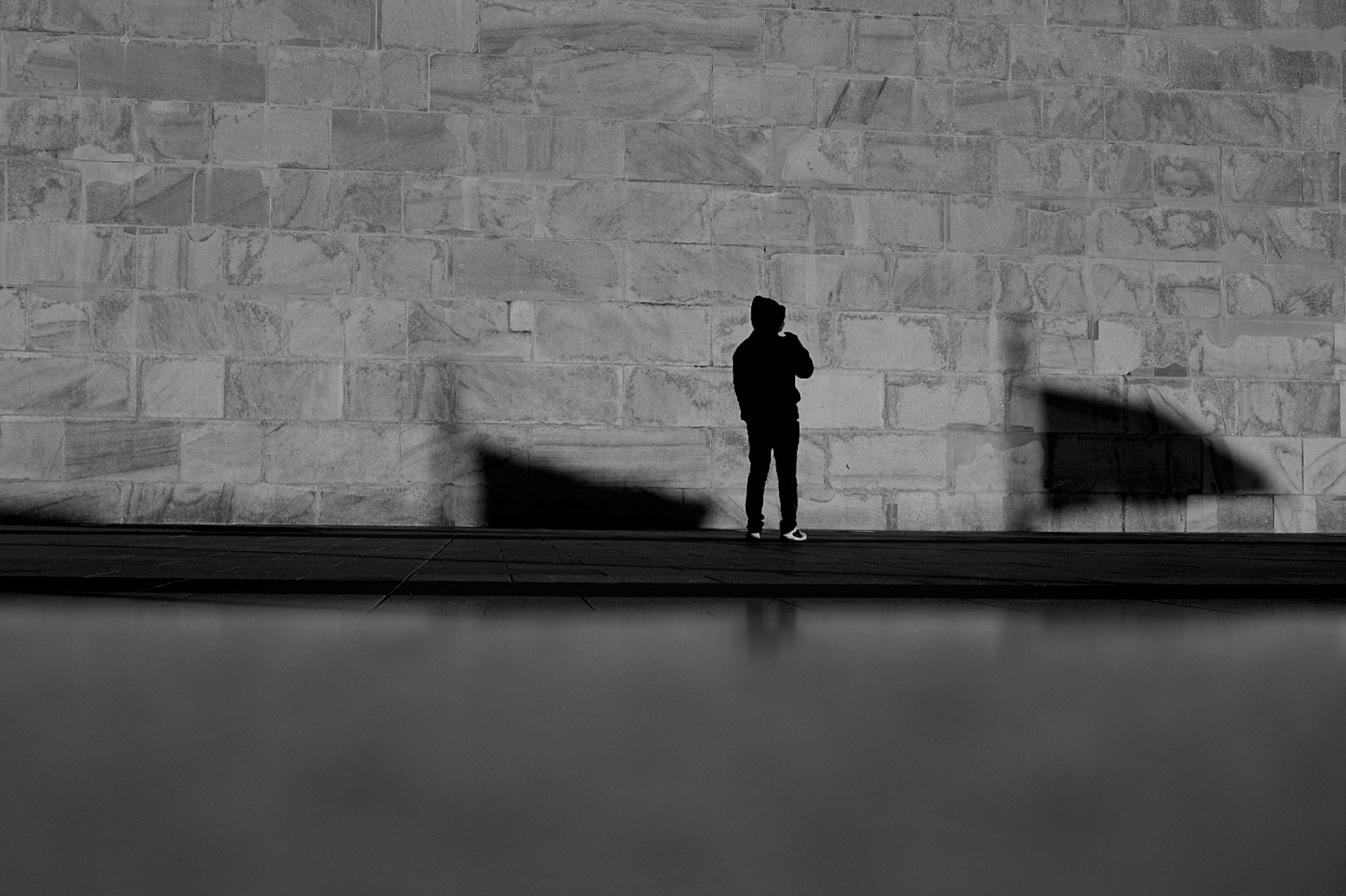
A Man Silhouetted Against the Washington Monument
One of the classic challenges in street photography is creating a sense of depth — the feeling that there's a world behind your subject, not just a flat backdrop. The Monument solves this problem architecturally. The base, the steps, the reflecting pool in front — all of it creates natural layering that separates subjects into foreground and background without any compositional gymnastics on your part.
Look at the black-and-white shot of the lone figure standing against the wall, silhouetted against the pale marble. The flags in the foreground — blurred and dark — frame him at both sides. The reflecting pool floor creates a visual floor line. The figure is small against the wall but somehow commanding. That tension between the individual and the monumental is something you can find again and again at this location, and it's part of what makes it such fertile ground for street photography.
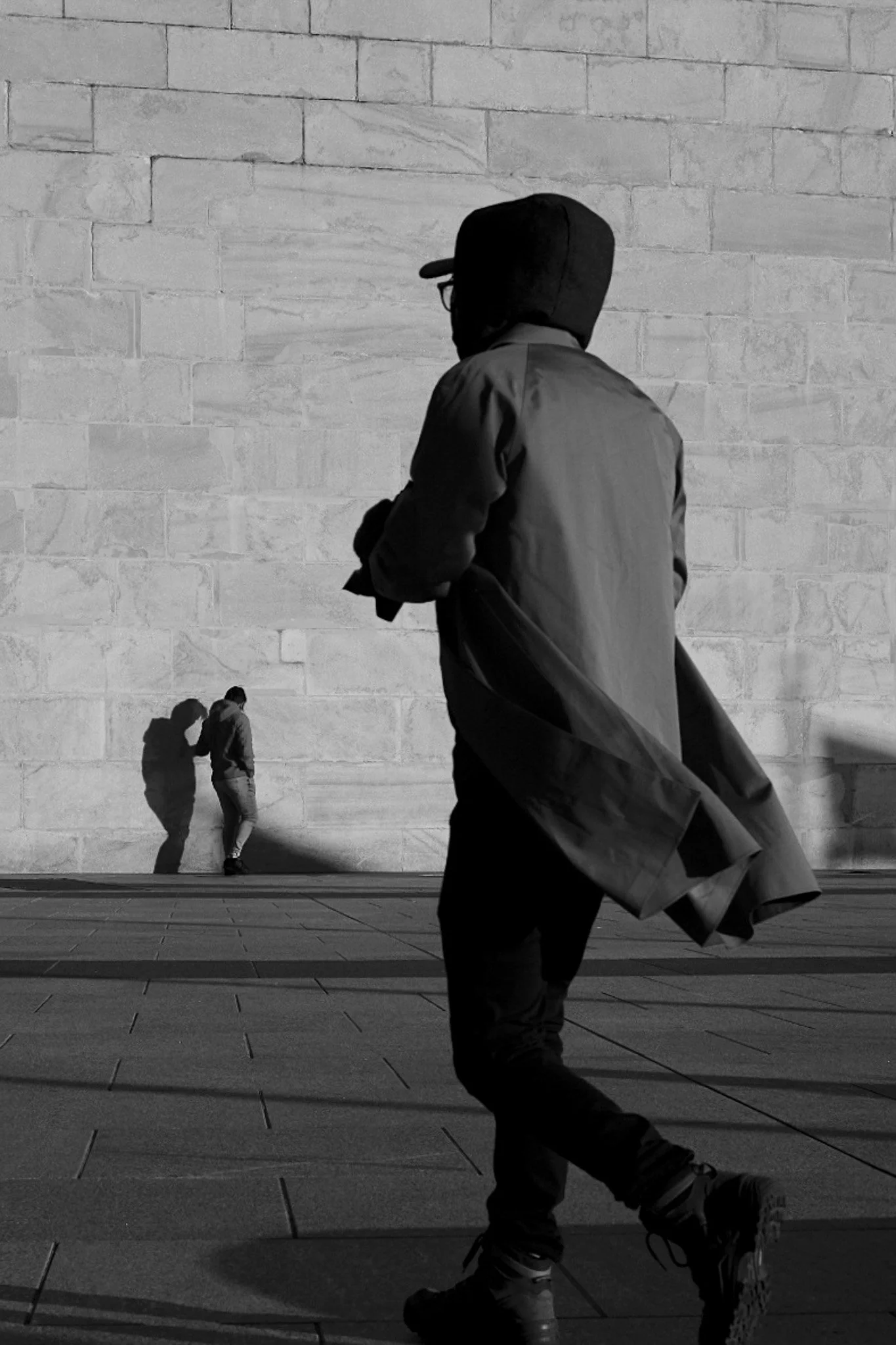
A Man in a Windblown Coat Walks in front of the Washington Monument
The other B&W image pushes this even further: a figure in a long coat strides into frame in the near foreground while, far in the background, two people stand close together — their shadows climbing the wall behind them. Foreground, midground, background. The Monument's open plaza gives you room to let all three coexist.
The Flag as Visual Element
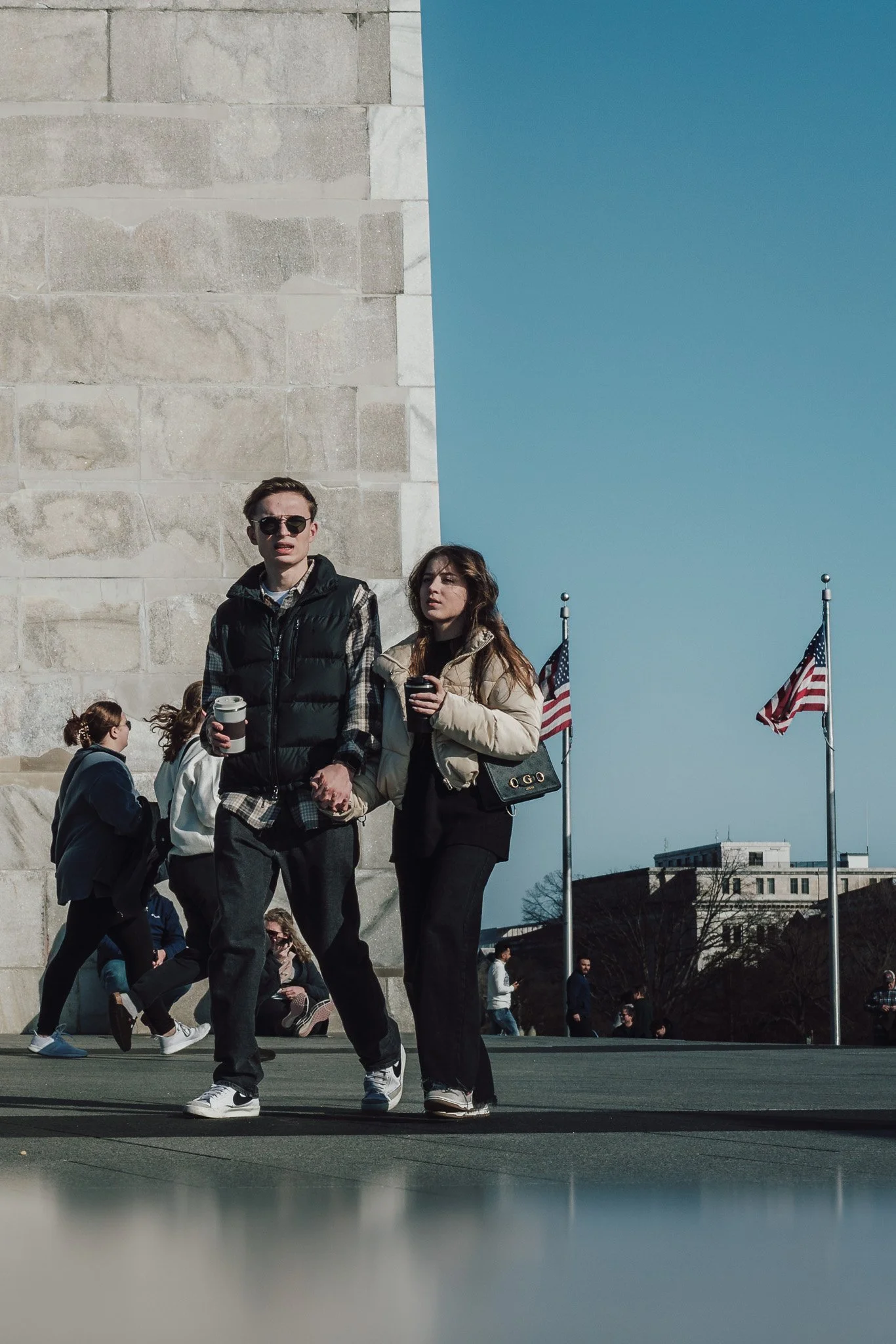
A Couple Drinking Coffee While Touring the Washington Monument
Washington DC is a city of flags, and nowhere is that more apparent than at the Washington Monument, where American flags ring the base on tall poles. In street photography, flags are gold — they're graphic, they carry emotional weight, and they flutter unpredictably in ways that add motion and drama to an otherwise static scene.
The image of the couple walking — coffee cups in hand, the Monument's corner cutting diagonally behind them — works in part because of the flags receding into the midground. The couple is relaxed, anonymous in the way that great candid street photography subjects often are. But those flags ground the image in place and give the scene a gravitational pull that a blank wall never could.
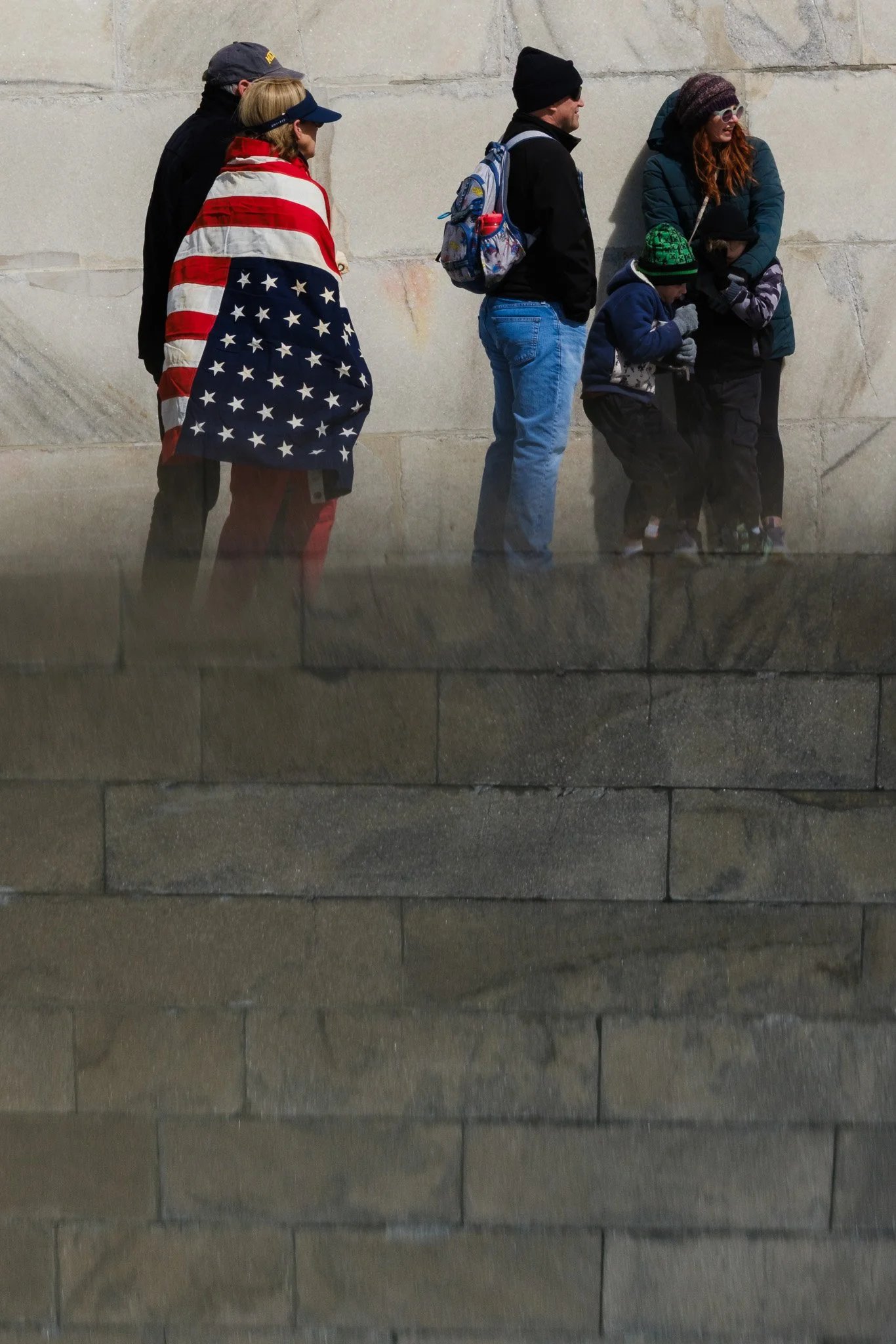
Flag Draped Visitor to the Washington Monument
The image of the woman wrapped in an American flag takes that idea even further. She becomes a walking symbol, draped in the same iconography that's planted all around her. It's the kind of layered, self-referential visual moment that you just can't manufacture — you have to be there, paying attention, ready to shoot. As I wrote in The Shot You Didn't Plan: Finding Serendipity in DC Street Photography, the best frames at DC's public landmarks often come from resisting the urge to pre-visualize and just staying open to what's in front of you.
Subculture and Surprise
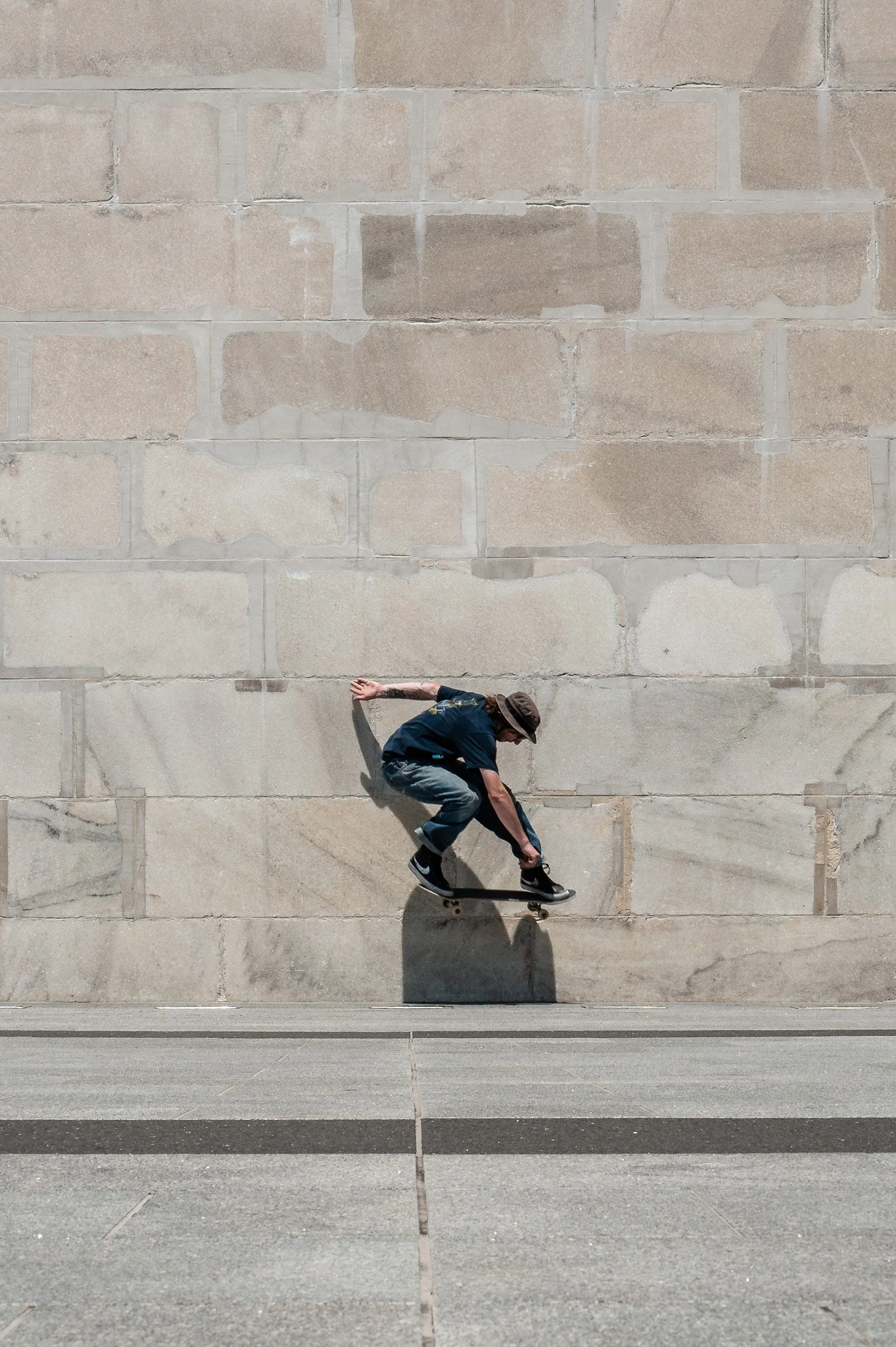
A Skateboarder Doing Tricks at the Washington Monument
One of the best things about the Monument grounds is that they attract everyone. Tourists, yes — but also locals, skaters, protesters, dog walkers, families. The public plaza around the base is one of those rare urban spaces in DC where people from completely different worlds share the same patch of pavement without really interacting.
The skateboarder mid-trick, shot in warm afternoon light against the same marble wall that appears in half the other images in this set, is a perfect example. He belongs here as much as the family with the flag. The wall behind him is neutral, the light harsh and clean, and the shadow he throws doubles his silhouette beautifully. Finding that kind of energy at a site this steeped in civic solemnity is exactly the kind of contrast that keeps street photography interesting.
For DC-based street photographers, the Monument grounds pair naturally with shooting the National Mall during events and protests — the location becomes even more electric when something's happening nearby.
Practical Notes
A few things worth knowing if you're planning a dedicated shoot here:
The light is best in the morning (east-facing walls lit up, long shadows reaching across the plaza) and in the late afternoon (golden side-light raking across the marble). Midday in summer can be brutal and flat — though the harsh shadows do create interesting B&W opportunities, as the skater shot shows.
The reflecting pool at the base is glass-smooth on calm days and creates genuine reflection opportunities. The horizontal line where the plaza meets the pool acts as a natural compositional guide.
Weekends bring more life and variety. Presidential inauguration periods and major rallies on the Mall transform the entire area — if you want to understand how civic energy changes this location, revisit my coverage of shooting the No Kings rally for a sense of how the Monument grounds operate when DC is charged.
Finally: the Monument is photographed constantly by tourists. As someone pointing a camera around, you're invisible here in the best possible way. Nobody thinks twice. That invisibility — the ability to move and observe without drawing attention — is one of the fundamentals that take time to internalize when you're starting out in street photography, and the Monument is a great place to practice it.
DC has no shortage of great street photography locations. But the Washington Monument keeps earning its place at the top of the list — not because of the obelisk itself, but because of everything happening at its feet.